
Think about how you protect your home. You don’t just lock the door – you’ve probably got a compound wall, a camera near the gate, and maybe a guard watching the street at night. No single one of these stops every kind of intruder. Together, they make your home a hard target.
IT security works the same way, yet most businesses still treat it like one lock on the door. A firewall here, an antivirus subscription there, and a hope that nothing slips through. But today’s attackers don’t attack – they look for the one window someone forgot to latch. That’s why IT network security has moved away from being “one tool that protects everything” and become layered instead: multiple independent checks, each covering the other’s blind spots.
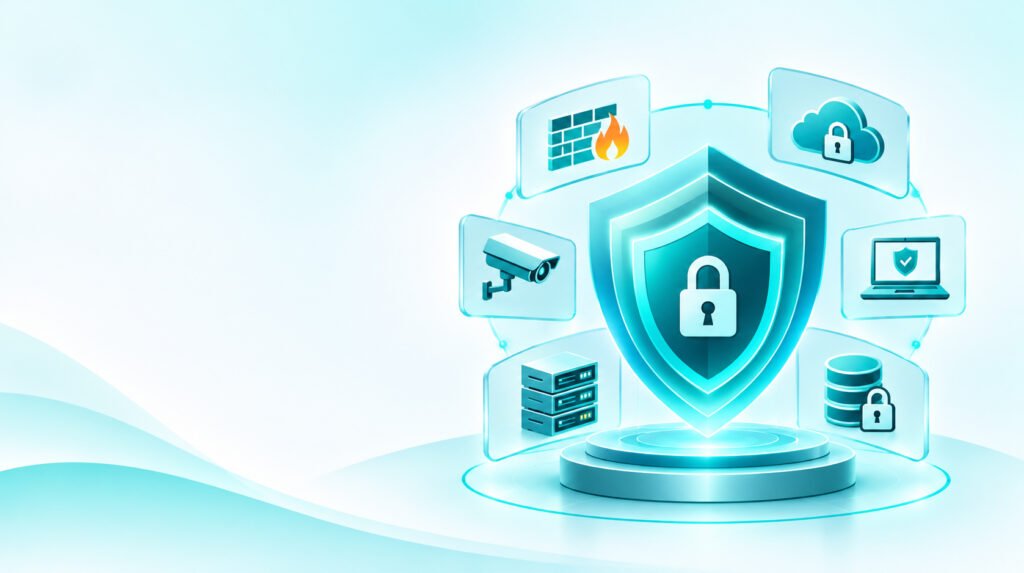
If you’re running enterprise computing solutions for a growing business, this isn’t a detail to leave your IT guy and forget – it’s what decides whether a bad day stays a bad day or becomes a business-ending one.
This is called defense-in-depth: assume something will fail and build the system so that one failure doesn’t bring the whole house down. It combines cyber security and data protection across your network, cloud accounts, physical office, and every device that touches company data. Here’s why this layered approach has become the industry standard.
The Rising Complexity of IT Network Security Threats
Here’s something most people don’t realize: attackers rarely use just one trick anymore. A typical breach today might start with a convincing email, move into stolen logic credentials, and end with the attacker quietly copying files for weeks before anyone notices.
It’s less like a break-in and more like someone slipping in through the delivery entrance, blending in with staff, and walking out with the cash register nobody was watching. That’s what makes network IT security so much harder than it used to be – you’re not just guarding the front door; you’re just watching someone who’s already inside pretending to belong.
This is where a network intrusion detection system earns its keep. A firewall is like a bouncer checking IDs at the entrance – useful, but only at the door. An intrusion detection system is more like the guy quietly watching the room, noticing when someone who came in as a guest starts poking around in the manager’s office. It flags behaviour that looks wrong, even from someone who technically already got in.
Quick Answer: Layered security matters because no single tool – firewall, antivirus, or a strong password policy – can catch every kind of modern attack on its own. Each one is good at stopping a different kind of trouble.
- Attackers chain several tricks together in one attack, not just one
- A locked front door does nothing if the threat is already inside
- Ongoing monitoring catches the slow, quiet stuff that rules-based tools miss
Building a Strong Foundation with IT Security Firewall and Next-Gen Protection
Every layered setup still needs a solid perimeter to start with, which means investing in a real IT security firewall, not the basic one that shipped free with your router years ago. Old-style firewalls check traffic against a fixed list of rules – like a security guard who only knows to stop people carrying a weapon in plain sight but wouldn’t notice someone hiding something under their coat.
That’s not good enough anymore, which is why next generation firewalls and IPS systems have become the norm for any serious enterprise setup – they look inside the traffic itself, understand which applications are talking, and catch threats hiding in what looks like normal activity.
For businesses growing fast out of Coimbatore, or manufacturing hubs like Tiruppur and Erode, this matters even more, because IT infrastructure tends to expand faster than in-house security know-how does. A good next-gen firewall doesn’t just block the obvious stuff – it notices when someone’s quietly moving a large chunk of data out at 2 AM, even if nothing about the connection looks technically “wrong” on the surface.
And this isn’t a set-it-and forget-it job either. New threats show up daily, so firewall rules need regular review – think of it less like installing a lock and more like changing the locks periodically because you never know who’s got a copy of the old key. Our team reviews client firewall rules on a set schedule for exactly this reason.
Cloud IT Security and Cloud Network Security for Distributed Teams
A lot of businesses have quietly moved most of their work to the cloud without really updating how they think about security. Your data isn’t sitting in one office server room anymore – it’s spread across data centers you’ll never see, assessed by people working from home, from client sites, from their phones on a train. Cloud IT security must protect data that moves, not just a location that stays still, which means encryption and access rules need to travel with the data itself, wherever it goes.
A lot of businesses have quietly moved most of their work to the cloud without really updating how they think about security. Your data isn’t sitting in one office server room anymore – it’s spread across data centers you’ll never see, assessed by people working from home, from client sites, from their phones on a train. Cloud IT security must protect data that moves, not just a location that stays still, which means encryption and access rules need to travel with the data itself, wherever it goes.
Cloud network security covers the connections between your cloud accounts, your office network, and everyone accessing things remotely. Most cloud breaches you read about in the news aren’t because hackers cracked some brilliant code – they got in because someone left a setting open that should’ve been locked, like leaving your car unlocked in a busy parking lot and assuming no one would try the door.
For teams split across offices in Coimbatore, Chennai, or Madurai, all logging into the same shared systems, getting this right from the start matters far more than fixing it after something’s gone wrong. Enterprise computing solutions built with cloud security in mind from day one saves businesses the much bigger cost of cleaning up a breach later.
Physical IT Security and Data Centre Security in a Digital-First World
It’s easy to think of security as something that only happens on a screen, but physical IT security is just as real a layer – and it’s the one people who forget until it’s too late. Your server room, your network cabinets, the actual boxes running your business – these need controlled access and monitoring the same way your digital systems do. A locked door with no camera is just as risky as a firewall with no monitoring behind it.
Data center security brings both sides together – who can physically walk in, and a digital trail of exactly when they did. Biometric locks, cctv surveillance cameras, and alerts for things like a server room suddenly overheating all protect hardware that, if someone simply walks off with it, makes every password and firewall you’ve set up completely pointless.
This is the layer most businesses skip, assuming firewalls and antivirus cover everything. But think about it this way – you could have the best alarm system in the world, and it means nothing if someone can just carry the safe out the back door.
Endpoint Management and Identity and Access Management in Cyber Security
Every laptop, every phone, every workstation connected to your systems is basically a door into your business – and most businesses have far more of these doors than they realize. Endpoint management is about knowing what’s happening on each of these devices – whether they’re updated, whether something looks off, whether an old laptop someone forgot to hand back is still quietly connected to company email.
Alongside that sits identity and access management in cyber security, which is really just a fancier way of asking; does this person actually need access to this? Most breaches don’t happen because someone hacked a brilliant encryption algorithm – they happen because one employee had far more access than their job needed, and their job needed, and their password got stolen.
Multi factor authentication is the equivalent of asking for ID even after someone’s shown you a key – an extra check that stops a stolen password from being enough of its own.
Quick answer: Solid endpoint and identity management usually looks like this:
- Every device is checked and updated before it becomes a weak spot
- People get access based on what their role actually needs – nothing more
- A second layer of verification means a stolen password alone isn’t enough to get in
IT Security Audit, Governance, Risk and Compliance
All these layers only work if someone actually checks that they’re working, which is why an IT security audit shouldn’t be something you scramble to do after a scare – it should be routine, like a regular health checkup rather than a trip to the ER. Audits tend to uncover the stuff daily work hides – an old firewall rule nobody remembers adding, an ex-employee’s login that was never removed, software that hasn’t been updated in a year.
This ties into IT security governance risk and compliance, which sounds intimidating but really just means: are your security decisions actually matching what your business and the law require? For companies handling sensitive customer or financial information, this isn’t paperwork for its own sake – it’s proof that your defenses aren’t just there for show.
A thorough audit also strengthens your data leak prevention solution, showing exactly where sensitive data actually flows – through email, shared drives, third-party tools – and where it’s most likely to slip unnoticed.
Choosing Managed IT Security Service Providers for Long-Term Protection
Realistically, building and maintaining every one of these layers in-house is a full-time job most businesses can’t staff on their own. This is where managed IT security service providers like Park Infotech step in — offering round-the-clock monitoring and best endpoint detection and response, so incidents get caught and handled fast, without you needing to hire and train a whole security team from scratch.
Working with an experienced IT security solutions company means all these pieces — network, cloud, physical, endpoints — work as one coordinated system instead of a pile of separate tools nobody’s watching together. Park Infotech’s managed IT services security brings exactly that coordination, turning security from something you worry about occasionally into something that just quietly works in the background — protecting your uptime, your reputation, and the trust your customers place in you.
Layered Security isn’t Overkill – it’s the Standard
Frequently Asked Questions
1. What is Layered Security, and why do businesses need it?
Layered security (defense-in-depth) uses multiple independent protections, so if one fails, the others still catch the threat. No single tool like a firewall or antivirus can stop every modern attack on its own.
2. How is a next-gen firewall different from a traditional one?
Old firewalls only check traffic against fixed rules. Next-gen firewalls with IPS look inside the traffic, understand which application are talking, and catch threats hiding in normal-looking activity.
3. Why is physical IT security still important?
Your server room and network cabinets hold the hardware running your business. If someone can simply walk off with it, every password and firewall becomes pointless. Biometric locks, CCTV, and access monitoring close that gap.
4. What is identity and access management, and how does it prevent breaches?
It means giving people access only to what their role needs, backed by multi-factor authentication. That way. One stolen password isn’t enough to get into your system.
5. How can Park Infotech help with IT security in Coimbatore?
Park Infotech offers managed IT security with the round-the-clock monitoring and endpoint detection and response. We bring your network, cloud, physical, and endpoint security together as one coordinated system.